Businesses that need regular facility cleaning generally have two broad options: build and manage an internal cleaning team or outsource janitorial services to a professional cleaning company. Neither model is automatically better for every business. The right choice depends on the size of the facility, cleaning requirements, staffing needs, management resources, and total cost.
The important comparison is not simply the hourly wage of a cleaner versus the price of a cleaning contract. A business should consider the full operational cost and management responsibility associated with each model.
Short answer
In-house cleaning vs. outsourcing janitorial services: the short answer
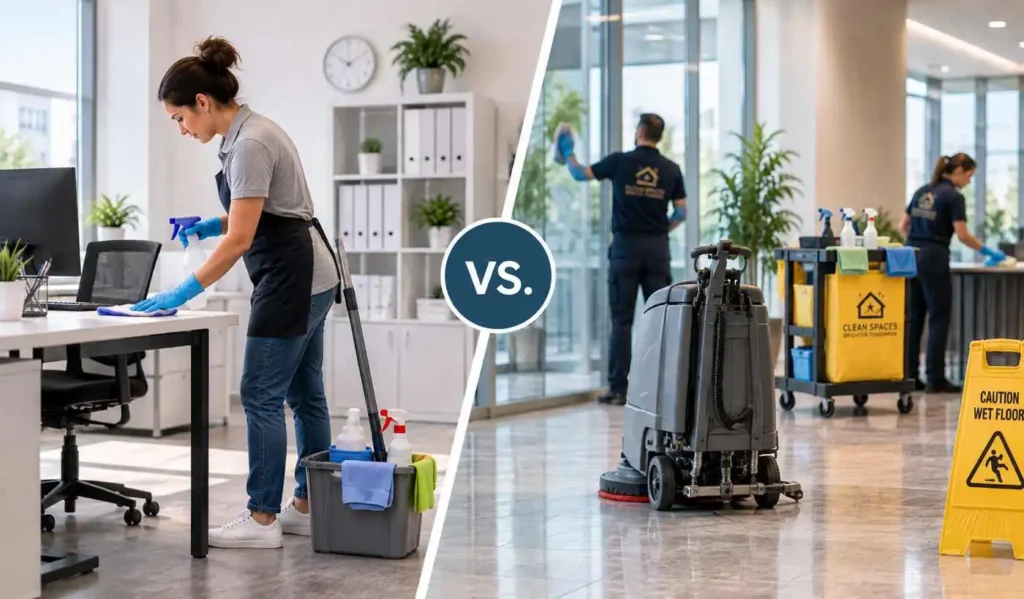
In-house cleaning
The business employs and manages its own cleaning personnel. The company is generally responsible for recruiting, scheduling, supervision, payroll, employee coverage, equipment, supplies, and day-to-day management.
Outsourced janitorial services
An external cleaning company provides the agreed cleaning services under a service contract. The provider typically manages its own cleaning staff and operational processes, while the client manages the relationship and the agreed scope of work.
For many businesses, the main difference is therefore not simply who cleans the building. It is who is responsible for managing the cleaning operation.
In-house
What does in-house cleaning involve?
With an in-house model, the business creates its own cleaning operation. Depending on the facility, this may involve one employee or a larger internal team. The business may be responsible for:
- Recruiting and hiring cleaning employees
- Scheduling shifts and coverage
- Managing payroll and employee administration
- Training employees for assigned cleaning tasks
- Supervising cleaning performance
- Managing employee absences and turnover
- Purchasing cleaning equipment and supplies
- Establishing cleaning procedures and checklists
- Handling performance and staffing issues
The exact responsibilities depend on how the company’s facilities and human resources functions are organized.
Outsourcing
What does outsourcing janitorial services involve?
When janitorial services are outsourced, the business contracts with an external cleaning provider to perform an agreed scope of work. The cleaning company typically handles its own employee staffing and operational management. The client and provider agree on important details such as:
- Areas to be cleaned
- Cleaning tasks
- Service frequency
- Cleaning schedule
- Access procedures
- Supplies and equipment responsibilities
- Quality expectations
- Communication and service procedures
A well-defined agreement is important because the quality of an outsourced service depends heavily on whether both parties understand what is included.
Side by side
In-house cleaning vs. outsourced janitorial services
| Factor | In-house cleaning | Outsourced janitorial services |
|---|---|---|
| Hiring | Business handles recruitment and hiring | Cleaning provider handles its own staffing |
| Payroll | Business manages employee payroll and administration | Provider manages its employees’ payroll |
| Supervision | Managed internally | Typically managed by the cleaning provider |
| Absence coverage | Business must arrange coverage | Provider manages staffing coverage under the agreement |
| Equipment | Usually purchased and maintained by the business | Depends on the service agreement |
| Supplies | Usually managed internally | Depends on the service agreement |
| Schedule | Direct internal control | Agreed with the service provider |
| Administrative workload | Generally higher | Generally lower for the client |
| Scaling service | May require recruiting or reallocating employees | May be easier to adjust through the service agreement |
In-house pros
Potential advantages of in-house cleaning
Direct day-to-day control
An internal team gives the business direct control over employees, schedules, procedures, and priorities.
Direct integration with internal operations
In-house cleaners can be managed as part of the organization’s existing facilities or operations structure.
Practical for large, consistent operations
A business with a large facility, substantial ongoing cleaning requirements, and an established facilities-management operation may have a reason to maintain an internal team.
However, this does not mean in-house cleaning will automatically cost less. The full cost of employment, management, equipment, supplies, coverage, and administration should be evaluated.
In-house cons
Potential challenges of in-house cleaning
Hiring and retention
The business is responsible for recruiting employees and dealing with vacancies and turnover.
Employee coverage
If a cleaner is absent, the business needs a plan for maintaining the required level of service.
Management time
Supervising schedules, supplies, performance, and staffing can require management attention that could otherwise be used for core business activities.
Equipment and supplies
Depending on the operation, the business may need to purchase, store, and maintain cleaning equipment and supplies.
Outsourcing pros
Potential advantages of outsourcing janitorial services
Reduced staffing administration
The cleaning provider handles its own employees, which can reduce the amount of recruiting, scheduling, and day-to-day staffing administration handled directly by the client.
Less operational management
Instead of managing individual cleaners, the business manages the service relationship, scope, schedule, and expected results.
Flexible service structure
A cleaning agreement can be structured around the facility’s required frequency and cleaning window. Additional or periodic services can also be scheduled when needed.
Access to an established operation
An established cleaning company may already have staffing procedures, supervisors, equipment, cleaning processes, and operational systems in place.
These advantages do not guarantee lower costs or better results. The quality of the provider and the details of the agreement still matter.
Outsourcing cons
Potential challenges of outsourcing
Less direct employee control
The cleaners are employees of the service provider rather than the client. The business manages performance through the agreed service relationship rather than direct employment.
Contract and scope management
A poorly defined scope can create confusion about which tasks are included, how often they should be performed, and what constitutes additional work.
Provider quality matters
Outsourcing transfers much of the operational responsibility to the provider. Businesses should evaluate communication, supervision, staffing practices, quality control, and the actual scope of service before signing.
The cost question
Does outsourcing janitorial services cost less?
There is no reliable universal answer. Comparing only an employee’s wage with a cleaning company’s quoted price does not provide a complete cost comparison.
An in-house cleaning operation can involve direct and indirect costs such as wages, payroll administration, hiring, training, employee coverage, supervision, equipment, supplies, and management time.
Outsourcing creates a contract or service expense, but the provider’s price reflects the scope of work, staffing, operating costs, supplies or equipment included, and other terms of the agreement.
The appropriate comparison is therefore the total cost of delivering the required cleaning service under each model, not simply the hourly labor rate.
In-house fits
When does in-house cleaning make sense?
An in-house model may be worth considering when a business has substantial and predictable cleaning requirements and already has the management infrastructure needed to operate an internal cleaning team.
It may also make sense when the organization requires direct internal control over staffing, schedules, and procedures and is prepared to manage the associated responsibilities.
Outsourcing fits
When does outsourcing janitorial services make sense?
Outsourcing can be particularly practical for businesses that do not want cleaning operations to become an internal staffing and management function.
It may also be appropriate when a business wants recurring cleaning with a defined scope and schedule without building a dedicated internal cleaning operation.
For many offices and commercial facilities, the main attraction is not necessarily that outsourcing is always cheaper. It is that the business can delegate much of the operational work associated with running the cleaning function.
Ask first
Questions to ask before outsourcing janitorial services
- What areas are included in the recurring cleaning program?
- Which tasks are completed at every visit?
- How frequently will the facility be serviced?
- Who provides cleaning equipment and supplies?
- Who supervises the cleaning team?
- How are absences and staffing changes handled?
- How is service quality monitored?
- Who is the main point of contact?
- What happens when additional cleaning is required?
- What are the contract terms and cancellation requirements?
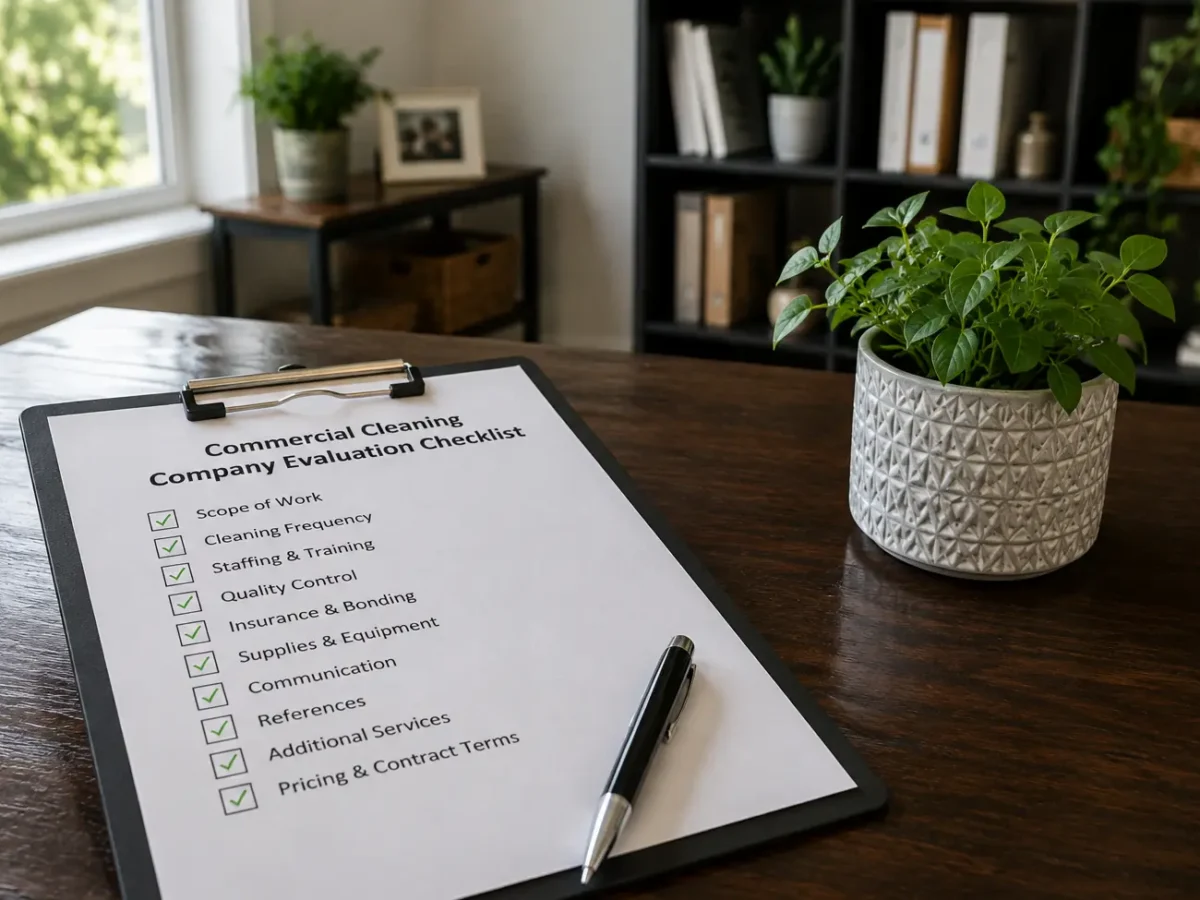
For a broader provider-selection checklist, see: How to choose a commercial cleaning company: 10 questions to ask.
After hours
What about after-hours janitorial service?
Outsourced janitorial services can often be scheduled outside normal business hours when the facility and provider can support that arrangement.
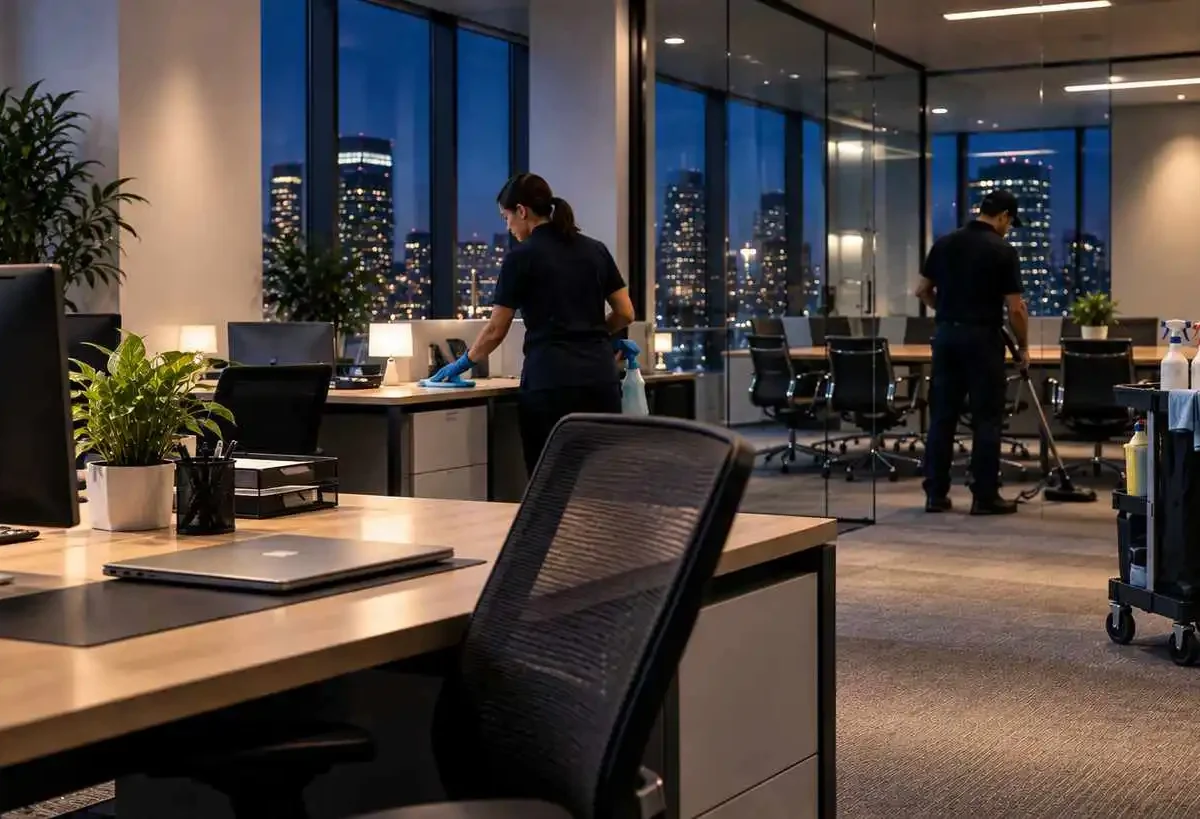
Evening or early-morning cleaning may be useful for businesses that want routine cleaning performed when fewer employees and visitors are present.
Learn more: After-hours office cleaning: benefits for businesses.
Deciding
How to make the decision
Start with the actual cleaning requirements of the facility. Determine the number of cleaning hours needed, required frequency, operating schedule, staffing requirements, equipment needs, and level of supervision.
Then compare the full internal operating cost with proposals from qualified cleaning providers that offer the same scope of work.
A meaningful comparison should answer one question: which model provides the required level of cleaning with the most practical combination of cost, management effort, control, and reliability for the business?
Bottom line
In-house or outsourced janitorial services?
There is no single answer that applies to every business. An internal cleaning team can provide direct control, while outsourcing can shift much of the staffing and operational responsibility to a professional cleaning provider.
For businesses that prefer to focus internal resources on their core operations, outsourcing janitorial services can be a practical option. The decision should still be based on a clear comparison of the total cost, scope, management responsibilities, and expected service level.
If your business is considering recurring professional cleaning, learn more about our janitorial services.
Cleaning & Care ProfServices provides professional commercial and janitorial cleaning services for businesses throughout Fairfield County and Westchester County. Cleaning programs can be structured around your facility, operating schedule, traffic, and specific cleaning requirements.
Considering outsourcing your cleaning? Request a free estimate and discuss your facility’s needs →
Want this handled for you?
We provide insured, background-checked cleaning teams across Fairfield County, CT and Westchester County, NY. Free estimate, often within the hour.