

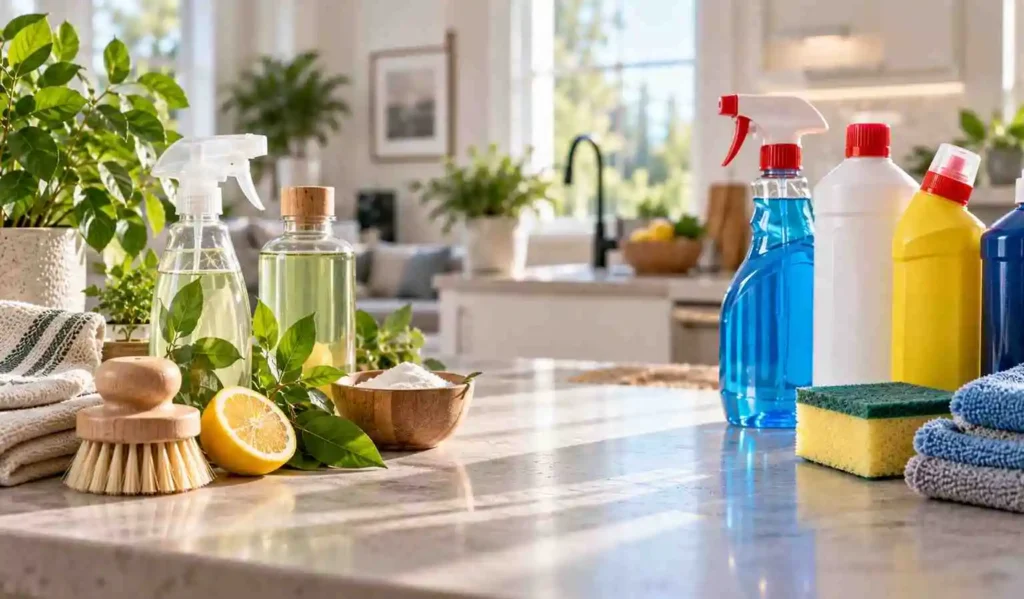
An evidence-based guide for residential and commercial cleaning
“Eco-friendly” cleaning has become an increasingly common selling point, but the label alone does not tell you whether a product is safer, more effective, or worth a higher price. A better question is: what is actually in the product, how has it been evaluated, and does it make a meaningful difference in the space where it is being used?
The answer is not a simple yes or no. For some homes and businesses, paying more for a better-evaluated cleaning product can be a sensible decision. In other situations, the extra cost may buy little more than branding.
This guide explains how to compare cleaning products, what the evidence says about several commonly discussed ingredient categories, when fragrance-free or certified products may make sense, and what to ask a professional cleaning company before paying a premium for “green cleaning.”
Definitions
What does “eco-friendly cleaning” actually mean?
The phrase “eco-friendly cleaning” sounds straightforward, but it is not a precise description of a product. Terms such as green, natural, plant-based, non-toxic, biodegradable, and eco-friendly are used differently by manufacturers, retailers, and consumers. A product can have one of these claims without necessarily meeting a recognized independent standard.
A better approach is to look at what the product is designed to do, what ingredients it contains, what hazards have been evaluated, and whether the environmental claims can be verified. The U.S. Environmental Protection Agency’s Safer Choice program is useful here because it evaluates every chemical ingredient in a certified formulation against human-health and environmental criteria within its functional class. Those classes include surfactants, solvents, preservatives, fragrances, and other ingredients used to make cleaning products work.
That is an important distinction: “safer” does not mean “chemical-free.” All cleaning products rely on chemistry. The question is whether the formulation uses ingredients with a more favorable hazard profile while still performing the job effectively.
Read the label
The ingredient list matters more than the marketing
Two bottles can both claim to be “green” and still have very different formulations. When comparing products, it helps to focus on the role of each ingredient rather than judging the product by its front label.
The table below is a practical starting point. It describes ingredient categories that commonly matter in cleaning products and the issues professional formulators and regulators consider when evaluating them.
Compare
Eco-friendly vs. conventional cleaning: what are you really comparing?
| Ingredient or function | Why it is used | What deserves attention |
|---|---|---|
| Surfactants | Lift oils and soil from surfaces | Biodegradability, aquatic toxicity, and degradation products |
| Solvents | Dissolve grease and other soils | Irritation, repeated-exposure hazards, VOC characteristics, and environmental fate |
| Fragrances | Add or modify scent | Respiratory sensitization or irritation concerns, transparency, and whether fragrance is necessary |
| Preservatives | Keep water-based products stable | Toxicological profile and whether a safer preservative can perform the required function |
| Builders / chelating agents | Improve cleaning performance in hard water | Aquatic effects, persistence, and the chemistry used to control water hardness |
| Disinfecting ingredients | Kill or inactivate microorganisms | Whether disinfection is actually necessary, the active ingredient, required contact time, and proper use |
EPA’s Safer Choice criteria reflect these kinds of questions. For example, its current surfactant criteria consider biodegradation, degradation products, and aquatic toxicity. Its solvent criteria address hazards such as acute toxicity, reproductive and developmental toxicity, repeated-dose toxicity, neurotoxicity, and environmental fate. This is much more informative than simply calling one product “green.”
Ingredients
Can a specific ingredient in a conventional product be a concern?
Yes, but the answer depends on the ingredient, concentration, route of exposure, and how the product is used. A professional article should not turn one ingredient into a blanket warning.
Consider 2-butoxyethanol, a solvent used in some cleaning formulations. NIOSH notes that exposure can affect the eyes, skin, kidneys, and blood, and that workers who use certain household cleaners can be exposed. EPA-linked toxicological information identifies eye and respiratory irritation as important effects of acute exposure. That does not mean every product containing 2-butoxyethanol is “dangerous” under normal household use; exposure depends on dose, duration, ventilation, and the specific formulation.
Another example is quaternary ammonium compounds, often called “quats,” which are widely used as disinfecting agents. Human occupational studies have reported asthma-related findings in some exposed workers, particularly in healthcare and cleaning settings. At the same time, the scientific literature also notes limitations in the available evidence, including difficulties separating quats from other workplace exposures and uncertainty about exposure thresholds. The responsible conclusion is not “quats are unsafe,” but rather that repeated occupational exposure to certain disinfecting agents deserves careful management, particularly where workers already have respiratory concerns.
Fragrance is another practical consideration. The American Lung Association recommends choosing cleaning products with no or reduced fragrances, VOCs, and irritants, and notes that green labeling alone does not guarantee a safer product. EPA’s current Safer Choice fragrance criteria exclude listed carcinogens, mutagens, reproductive or developmental toxicants, persistent/bioaccumulative/toxic compounds, and listed respiratory sensitizers from fragrances used in certified products.
These examples show why ingredient-level evaluation is more useful than a simple “natural versus chemical” argument.
Households
What about children and pets?
It is reasonable to think more carefully about cleaning products in homes with young children and pets, but claims should stay within the evidence.
Children can spend time close to recently cleaned floors, countertops, furniture, and other surfaces. Pets may also have direct contact with floors and may groom themselves after walking across a surface. Those facts make good product selection, correct dilution, adequate ventilation, and following label directions sensible precautions.
However, it would be misleading to say that a particular conventional ingredient is automatically dangerous to children or pets simply because it is not marketed as “eco-friendly.” Toxicity is dose- and exposure-dependent. EPA’s Safer Choice program evaluates products and ingredients with human health and environmental criteria and specifically describes the program as helping consumers identify products that are safer for families, pets, workplaces, and the environment.
For homes with children or pets, a useful priority list is simple: choose appropriately formulated products, avoid unnecessary fragrance when it is a concern, use the minimum effective amount, allow surfaces to dry as directed, ventilate the area when appropriate, and store all cleaning products securely.
Reality check
Is “eco-friendly” always safer?
No. “Eco-friendly” is not a scientific guarantee.
A product can be marketed with words such as natural, botanical, plant-based, or green while still containing ingredients that can irritate the skin or respiratory system. Conversely, a conventional-looking product can contain ingredients that meet rigorous safety criteria.
This is one reason independent standards are valuable. EPA’s Safer Choice label is not a claim that a product is harmless under every circumstance. It means the product and every chemical ingredient in its formulation have met the program’s criteria for safer products, while the product must also meet performance and other requirements.
The label therefore answers a more useful question than “Does this look green?” It asks whether the formulation has been evaluated against defined health and environmental criteria and still performs its intended cleaning function.
The premium
Should you pay more for eco-friendly cleaning products?
Sometimes — but not simply because the bottle says “eco-friendly.”
Paying more can make sense when you are getting a verified benefit: a formulation that meets a credible certification standard, reduced fragrance, a better-documented ingredient profile, a concentrated format that reduces packaging or shipping, or a product that is better suited to the people and environment in which it will be used.
Paying more may not make sense when the premium is based almost entirely on branding, vague environmental language, attractive packaging, or the assumption that “natural” automatically means safer.
For a household, the decision may come down to indoor-air comfort, fragrance preferences, children or pets, cleaning performance, and budget.
For a business, the calculation is broader. Cleaning staff may use products repeatedly, employees may spend many hours in the space, and a facility may have its own purchasing, sustainability, or indoor-environment policies. In a commercial setting, product selection is therefore part of a larger cleaning program rather than a one-time purchase.
At home
Eco-friendly cleaning for homes
For residential cleaning, the best choice is usually the product that provides the required result without unnecessary exposure or environmental burden.
General surface cleaning, kitchens, bathrooms, and routine dust and soil removal do not always require the most aggressive chemistry available. EPA’s greener-cleaning guidance notes that many routine cleaning tasks do not typically require disinfectants, especially on surfaces with minimal hand contact. Disinfectants should be used when the task actually calls for disinfection and according to label directions.
A professional cleaning company should also be able to explain what products it uses, whether fragrance-free options are available, and whether products are selected because of a real performance or safety criterion rather than because “green” sounds better in a marketing brochure.
At work
Eco-friendly cleaning for offices and businesses
Commercial cleaning deserves a slightly different standard because the same products may be used repeatedly across large areas and by multiple workers.
A thoughtful commercial program looks at product performance, dilution and dispensing, worker exposure, indoor odors, storage, waste, training, and whether disinfectants are being used only where they are appropriate. EPA’s greener-cleaning guidance also emphasizes proper product use and worker training.
For offices, childcare settings, professional practices, retail locations, and other occupied facilities, a good “green cleaning” policy should be practical. There is little value in choosing an environmentally preferable product that does not clean well, requires excessive product use, or is used incorrectly.
The strongest programs therefore focus on the entire process: the right product, the right dilution, the right equipment, the right frequency, and the right training.
Brands
What about specific brands and products?
There are legitimate reasons to mention real products, but brand names should be handled carefully.
This article does not endorse or discourage the purchase of any particular brand. Product formulas, packaging, certifications, and availability can change. Examples are included only to show that major manufacturers do participate in recognized safer-product programs.
EPA has identified companies such as ECOS, Seventh Generation, Clorox, and Simple Green as Safer Choice partners or manufacturers with Safer Choice-certified products. EPA also maintains a searchable, current database of products that meet its Safer Choice Standard, including filters for fragrance-free products.
For that reason, a product name by itself should never be treated as proof that every product from that brand is “eco-friendly” or safer. Check the exact product, its current certification status, ingredient information, and directions before making a decision.
Consumer reviews can be useful for learning about scent, packaging, streaking, or user experience, but reviews are anecdotal. They do not establish that a particular ingredient caused a health effect. Scientific studies, regulatory assessments, safety data, and verified certifications carry much more weight.
Certifications
What certifications should you look for?
For U.S. consumers and businesses, EPA Safer Choice is one of the clearest places to start.
The program evaluates every chemical ingredient in a certified product, applies functional-class criteria, and also considers product performance and other requirements. EPA maintains a public database of certified products and separately identifies fragrance-free products. When evaluating a “green” product, look for:
- A recognizable certification rather than a vague environmental claim.
- The exact product name and current certification status.
- Ingredient or safety information that is available and understandable.
- Clear directions for dilution, ventilation, contact time, and use.
- Evidence that the product is appropriate for the surface and task.
A credible certification does not eliminate the need to use a product correctly. It simply gives the buyer a stronger basis for comparison.
Fragrance
What about fragrance-free cleaning?
Fragrance deserves its own discussion because a cleaning product can perform well without leaving a strong scent behind.
A noticeable fragrance is not proof that a surface is cleaner. For some people, fragrances can be a source of irritation or discomfort, and the American Lung Association recommends reducing or avoiding fragrances in cleaning products when appropriate.
EPA’s Safer Choice program also has a specific fragrance-free designation. A product carrying that designation has met EPA’s criteria for fragrance-free products.
For a home or workplace where strong scents are undesirable, asking for fragrance-free products can be a more meaningful preference than simply asking for something “natural.”
Ask your cleaner
Questions to ask a cleaning company
Before booking a residential or commercial cleaning service, ask a few direct questions:
- Which products do you actually use?
- Are any of them EPA Safer Choice-certified?
- Do you offer fragrance-free options?
- Which tasks require a disinfectant, and which do not?
- Are products diluted according to the manufacturer’s instructions?
- Can you provide product names or safety information when requested?
- Does “green cleaning” change the price, and exactly what does the additional cost cover?
A professional company should be comfortable answering these questions. “We use green products” is a marketing statement; explaining the products, the process, and the reason for using them is professional service. For a broader list of things to check before you hire, see our guide to the questions to ask a commercial cleaning company.
Bottom line
So, is eco-friendly cleaning worth the extra cost?
In many situations, yes — but the value comes from the specific product and cleaning program, not the label.
A higher-priced product is worth considering when it offers a meaningful, verifiable advantage: a recognized certification, a better-documented formulation, lower fragrance, reduced environmental impact, or a format that works efficiently with less waste.
It is not automatically worth paying more when the only evidence is a green-colored package, a natural-sounding name, or a general claim that the product is “non-toxic.”
For homeowners, the best choice is usually a product that cleans effectively while fitting the household’s comfort, exposure, and environmental priorities. For businesses, the decision should also consider worker exposure, indoor conditions, purchasing policies, training, and the practical demands of the facility.
The most sensible approach is simple: pay for verified benefits, not for marketing.
Cleaning & Care ProfServices provides residential and commercial cleaning throughout Fairfield County and Westchester County, and uses eco-conscious cleaning products. We’re happy to discuss product choices, fragrance-free options, and cleaning scope for your home or facility.
Have questions about products or scope? Request a free estimate →
References
Sources and references
U.S. Environmental Protection Agency — Safer Choice Standard and Criteria
U.S. EPA — Safer Choice Master Criteria for Safer Chemical Ingredients
U.S. EPA — Safer Choice Criteria for Surfactants
U.S. EPA — Safer Choice Criteria for Solvents
U.S. EPA — Safer Choice Criteria for Fragrances
U.S. EPA — Safer Chemical Ingredients List
U.S. EPA — Search Safer Choice-Certified Products
U.S. EPA — Identifying Greener Cleaning Products
U.S. EPA — Frequently Asked Questions on Safer Choice
CDC/NIOSH — 2-Butoxyethanol
American Lung Association — Cleaning Supplies and Household Chemicals
PubMed — Occupational Asthma Caused by Quaternary Ammonium Compounds (Multicenter Cohort Study)
PubMed/PMC — Methodological Evaluation of Human Research on Asthmagenicity and Occupational Cleaning (Quats)
Want this handled for you?
We provide insured, background-checked cleaning teams across Fairfield County, CT and Westchester County, NY. Free estimate, often within the hour.